 Bioluminescence Tour Holbox
Punta Mosquito, Holbox: The Walk, the Tide and the Rules
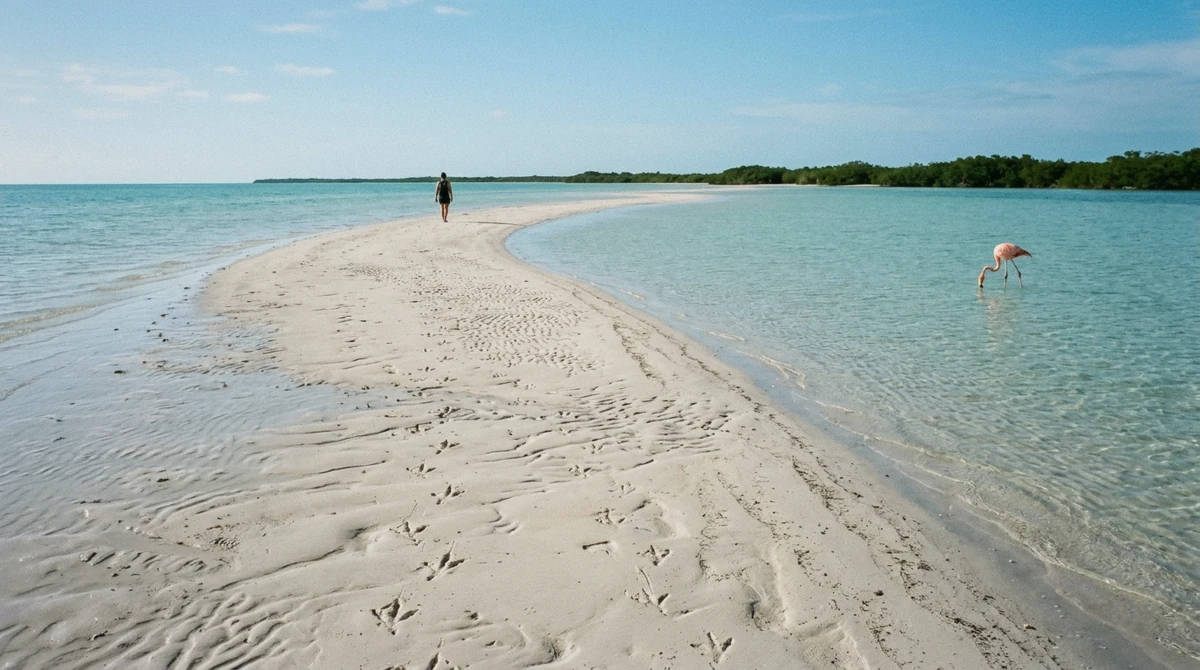
Punta Mosquito Holbox is the long sandbank at the eastern end of the island, and it is the single most misdescribed place on Holbox. Half the English guides put it on the northwest side, which is wrong. Most of them tell you to walk out onto the point, which is a preservation subzone of a federal protected area where recreational tourism is not among the permitted activities. This page is the walk, the tide that decides whether there is anything to walk on, the flamingos, the rules that actually apply, and what happens out there after dark.
Quick answer
Punta Mosquito is at the eastern end of Isla Holbox, roughly an hour on foot along the beach from town. The sandbank you have come to walk on only exists at low tide, so the tide table decides your morning. The tip itself is a 76.1358-hectare preservation subzone of the Yum Balam protected area and is roped off; you walk the beach and the bank toward it, not onto it.
Key takeaways
- About an hour each way on foot from the centre of town. Bicycles and golf carts are banned from the beaches by municipal rule, so this is a walk
- Check a tide table before you set out. At high tide the sandbank is under water and there is nothing to walk along
- The point is a preservation subzone under the Yum Balam management programme, and recreational tourism is not on its list of permitted activities
- Flamingos feed in the shallows here. Feeding wildlife and making noise that alters behaviour are both prohibited inside the subzone
- The dense night water sits offshore, which is why the two-hour Holbox bioluminescence kayak trip at $52 goes to the sandbars rather than the point
- Coming from the mainland first: see getting to Holbox from Cancún
The Trips That Reach the Water Off This Point
You can walk here in daylight for nothing. The water the kayaks reach after dark is a different place, several hundred metres further out and away from every light on the island. Prices from $52, free cancellation up to 24 hours ahead.
 from $51.93Most Booked — 4.6★, 300 Reviews
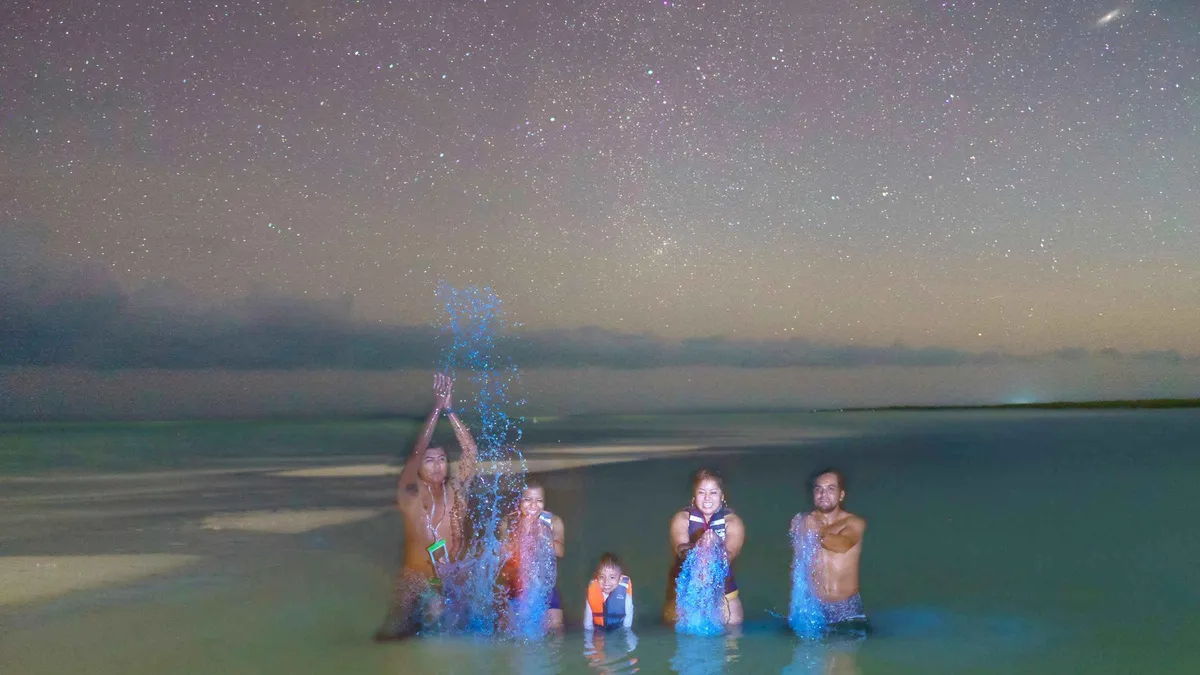
 Bioluminescence Kayak & Stargazing to the Punta Mosquito Sandbars
Two hours by kayak out to the Punta Mosquito sandbars, the darkest water within reach of town, with stargazing time away from Holbox's lights.
Check Availability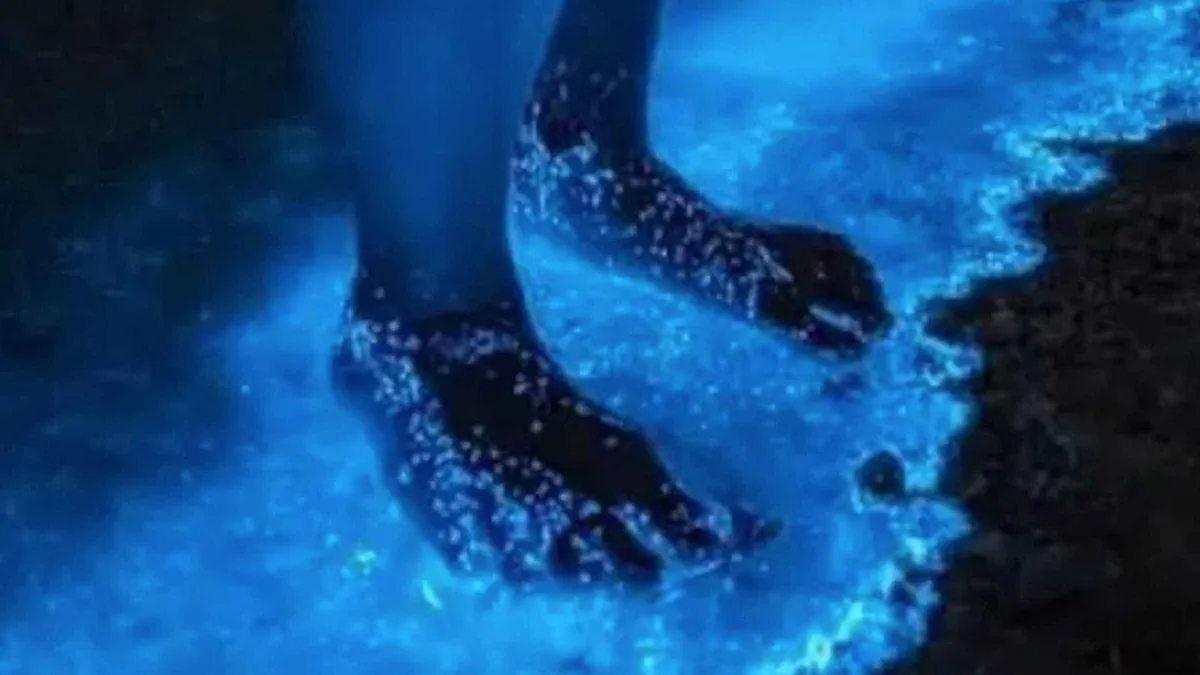 from $51.93Shortest — 90 Minutes
 Guided Night Kayak to the Glowing Sandbank
The compact version: an hour and a half of guided paddling to the glowing sandbank and back, at the same price as the longer sandbar trip.
Check Availability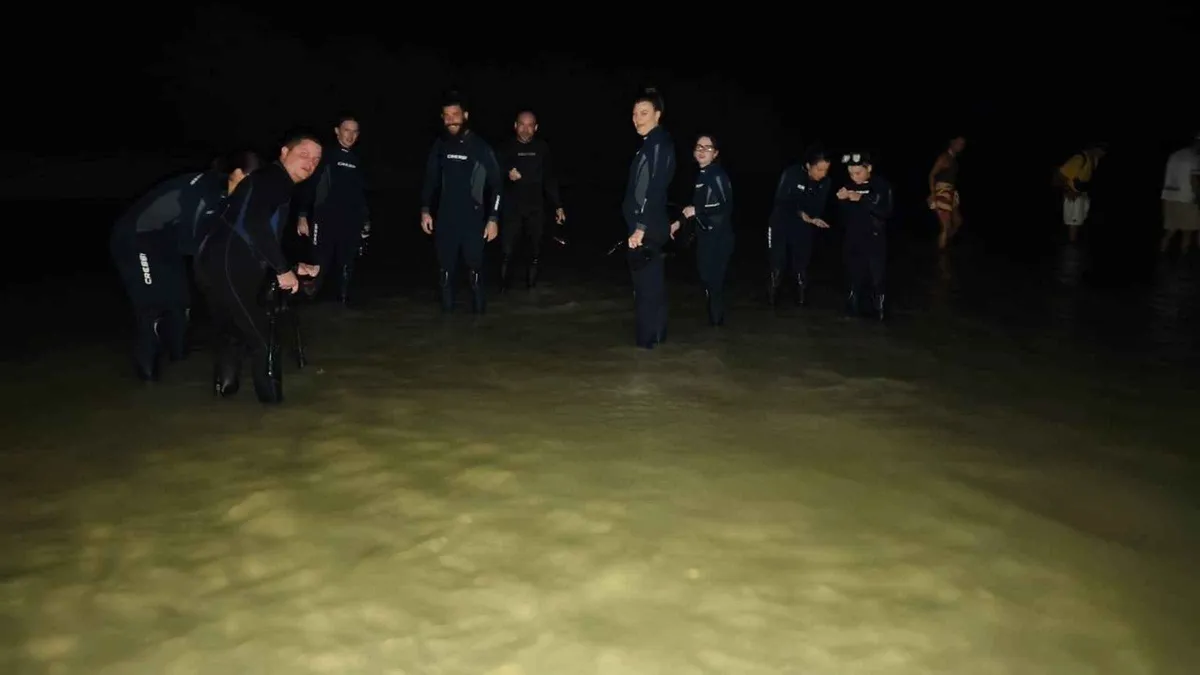 from $53.66In the Water — Wetsuit Swim
 Wetsuit Bioluminescence Swim with a SECTUR Guide
The only listing here that puts you in the water rather than on it. Wetsuit and mask, a SECTUR-certified guide, and a briefing on what makes the plankton…
Check AvailabilityWhere Punta Mosquito Is, and How to Reach It
The Eastern End, Not the Northwest
Punta Mosquito sits at the eastern end of Isla Holbox, past the hotel zone, roughly opposite Punta Cocos on the far western tip. A surprising number of English-language guides place it on the northwest of the island. It is not there, and following that description sends you an hour's walk in the wrong direction.
The geography is simple once you have it. Holbox town sits in the middle of the southern shore. Walk west along the beach and in twenty to thirty minutes you reach the sunset point at Punta Cocos. Walk east instead, past the last of the hotels, and after about an hour the shoreline narrows into a pale spit that runs out into shallow water. That spit is what people mean by Punta Mosquito.
The name is not decoration. This is a mangrove island and the eastern end is where the mangrove comes closest to the beach. Bring biodegradable repellent, put it on before you leave town, and do not put it on again if you are planning to go into the water.
It Is a Walk, and That Is Not Optional
There are no private cars anywhere on Holbox. The streets are sand and the traffic is golf carts and bicycles. That would suggest hiring a cart and driving east along the shore, and people do ask.
You cannot. Bicycles and golf carts are banned from the beaches, the sea and the sand banks by municipal rule, brought in after carts were found crushing dune vegetation and leaking fuel onto the sand. A cart can drop you at the end of the hotel zone. From there it is your own two feet.
Allow two hours for the round trip and more if you stop, which you will. Take water: there is nothing to buy at the eastern end, no beach club, no toilet, no shade beyond what the mangrove throws early in the day.
| Getting there | Time | Cost | Notes |
|---|---|---|---|
| Walking east along the beach from town | About one hour each way | Free | The only way to reach the spit itself |
| Golf cart taxi to the end of the hotel zone, then walk | 10 to 15 minutes, then 30 to 40 on foot | MXN 200 or so (about $12) for the cart, cash only | Carts cannot go onto the beach; agree the fare before you get in |
| By kayak on a guided night trip | Departure set the evening before | From $52 | Goes to the sandbars offshore, not to the point |
Map: Punta Mosquito and the Walk Out
Four points for orientation: the spit at the eastern end, the town you set out from, the ferry terminal you arrived at, and the western point for contrast.
The Part Almost Every Guide Gets Wrong
A Preservation Subzone, With a Published List of What May Happen There
The Área de Protección de Flora y Fauna Yum Balam was decreed in 1994 and covers roughly 154,000 hectares of mangrove, low forest, coastal dune, lagoon and sea. Its management programme, the document that says what may and may not happen inside it, was summarised in the Diario Oficial de la Federación on 5 October 2018.
Inside that programme there is a unit called the Subzona de Preservación Playas de Punta Mosquito, covering 76.1358 hectares. A preservation subzone is the strictest of the tourism-relevant categories, and the programme does not describe what is banned by listing every activity. It does the opposite: it lists what is permitted, and everything else follows from that list.
Here is the whole permitted list. Low-environmental-impact productive activities. Scientific collection of wildlife specimens. Scientific collection of forest biological resources. Construction and installation of infrastructure such as corrals and temporary camps for sea turtle conservation. Environmental education. Scientific research and environmental monitoring.
Recreational tourism is not on it. That is the accurate way to state the problem, and it is more useful than the flat word closed, which the blogs argue about. Nobody is stopping you walking the public beach and the low-tide bank toward the spit. The tip is roped and buoyed, and the operators' own tour descriptions say access to the point is prohibited before explaining that their trips go to the sandbars nearby instead.
What the Programme Prohibits, and What It Means on the Sand
The same document lists the prohibitions for the subzone in plain Spanish. These are the ones a visitor can actually break by accident.
| What the programme says | What that means where you are standing |
|---|---|
| Alimentar a los ejemplares o hacer ruidos intensos que alteren el comportamiento | No feeding anything, and no speakers, shouting or drones near the birds |
| Encender fogatas o usar linternas en la playa durante la época de anidación de tortugas marinas | No fires, and no torch beams on the beach during turtle nesting season, roughly May to October |
| El tránsito de vehículos en las playas | No carts, no bikes, no quad bikes on the sand, except for park administration and patrols |
| Atracar vehículos, aparatos o equipos motorizados a propulsión | No landing or mooring a motorised craft on the bank |
| Introducir ejemplares o poblaciones exóticas, tales como perros y gatos | Leave the dog at the hotel. This one catches people out |
| Recorridos en caballo sobre la zona federal y duna costera | No horse rides on the federal shoreline strip or the dune |
And the Plastic Rule That Applies Everywhere in Yum Balam
Across the whole protected area, the programme restricts single-use plastics by name: popotes, bolsas de plástico, envases o recipientes elaborados de unicel, PET o plástico. Straws, plastic bags, polystyrene and PET containers.
In practice that means carrying water in something refillable and taking every wrapper back to town with you. There is no bin at the eastern end and nobody empties one. What you carry out there, you carry back.
Last verified: August 2026.
Low Tide Decides Everything
The Bank Is Only There Half the Time
The thing people photograph at Punta Mosquito, the pale ribbon of sand running out into flat turquoise water with ripples showing through it, is a low-tide feature. At high tide the same ground is under half a metre of water and there is no ribbon at all, just shallow sea and a beach that stops.
So the tide table is the trip plan. Look up the Holbox tides for your date before you decide what time to leave, and aim to be at the eastern end within the hour or so either side of low water. That usually means an early start, which suits the walk anyway: an hour on open sand at midday in August, when the mean temperature runs near 28.3°C and there is no shade, is not a pleasant hour.
Early morning also gets you the birds. They feed on the falling and low tide, and by late morning both the water and the light have gone flat.
What to Take, and What to Leave
Nothing here is sold, rented or provided. Assume total self-sufficiency for two to three hours.
- More water than you think, in a refillable bottle rather than single-use plastic
- Biodegradable repellent, applied in town before you set off
- A hat and a long-sleeved shirt instead of sunscreen if you plan to go into the water at all
- Shoes or sandals you can walk in wet, for shell fragments on the bank
- Cash for the cart back if the walk defeats you on the return leg
- A bag for your own rubbish, including anything you find
- A tide table screenshot, since phone reception out here is patchy
The Flamingos, and How Close You May Go
They Are Feeding, Not Posing
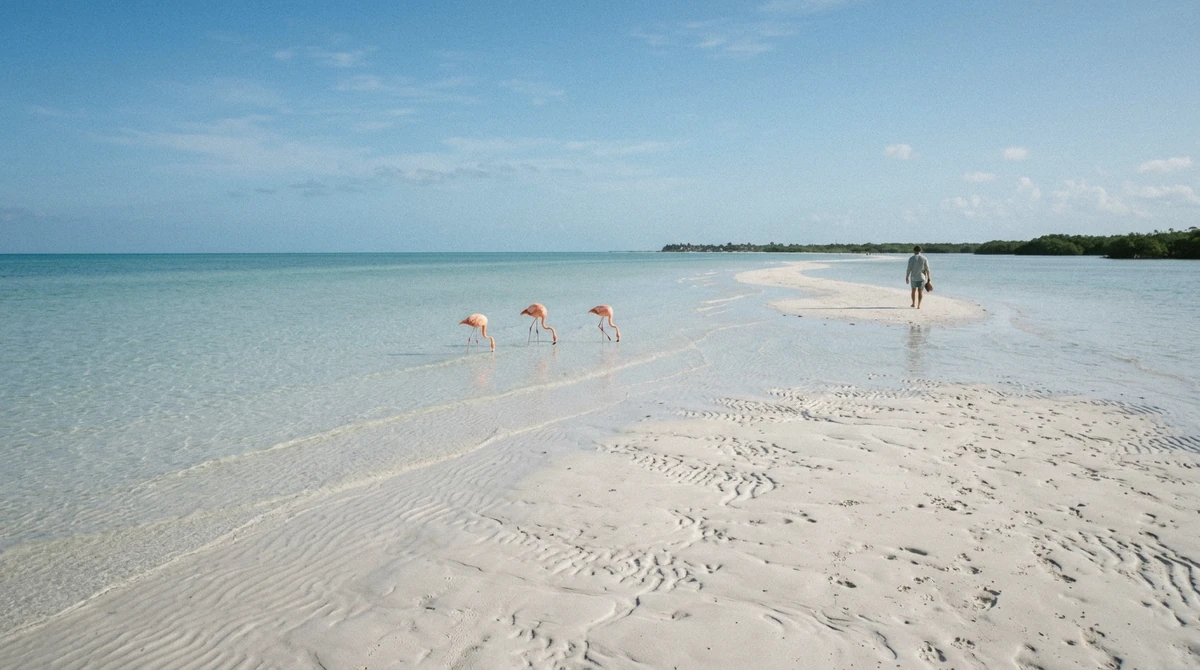
Flamingos work the shallows at the eastern end of the island, and on a good low tide you can see them from the bank without any equipment at all. They are the reason a lot of people make this walk.
The rule is the one already quoted from the management programme: feeding wildlife, or making noise intense enough to alter behaviour, is prohibited inside the subzone. In practice that means you stop where they are comfortable and you let them decide the distance. If a bird lifts its head, stops feeding and starts walking away from you, you are already too close and moving closer will simply end the sighting for everyone on the bank.
We would add the obvious. No drones. No wading out toward them to get a phone photograph. No throwing anything into the water to make them move. A pair of small binoculars does more for you than fifteen minutes of creeping forward, and costs the birds nothing.
Torches After Dark, and the Turtle Rule
The Rule Nobody Prints
Of everything in the Yum Balam management programme, the line that matters most on a bioluminescence island is this one: encender fogatas o usar linternas en la playa durante la época de anidación de tortugas marinas. Lighting fires or using lamps on the beach during sea turtle nesting season is prohibited inside the subzone.
Sea turtles nest on Holbox roughly from May to October, with hawksbill, loggerhead and green turtles all recorded. The peak of the arrivals is reported between May and July. Those months overlap almost exactly with the months operators rate the glow at its brightest, which is why the two subjects collide on this island and almost nowhere else.
The reason for the rule is that hatchlings orient toward the brightest horizon. A torch on a dark beach beats the sea, and they walk inland and die. A phone screen does the same thing at short range.
How to Behave With a Light on Any Holbox Beach at Night
This is worth applying island-wide between May and October, not only inside the subzone, because the turtles do not read the zone boundaries.
Keep the torch off unless you need it to see your feet. When you need it, point it down at the sand directly in front of you rather than out along the beach or across the water. Never sweep a beam over the sea. Use the dimmest setting you have, and a red light if your torch has one, because red carries far less far.
There is a second reason on a night like this one. Your eyes take fifteen to twenty minutes to adapt to darkness properly, and a single flash of white light resets that for everyone standing near you. On a night when the water is faint, night vision is most of what you have. It is the same reason flash photography is banned on every trip here.
Seeing the Glow Out at This End of the Island
Why the Water Is Better Here, and Why You Still Cannot Stand In It
The eastern end of Holbox has what the plankton want: shallow, warm, sheltered water, well away from the town's lights. The organism normally credited for the glow in warm Caribbean shallows is Pyrodinium bahamense, the same dinoflagellate documented in the bio bays of Puerto Rico and Jamaica's Luminous Lagoon. We could not find a published survey of the Holbox population, so treat the species as likely rather than confirmed. What is not in doubt is the habitat: it needs salinity above about 20 psu and water warmer than 22°C, and this lagoon is exactly that for most of the year.
The problem is that the good water sits offshore on the sandbars, not against the beach, and the point that would get you closest to it is the subzone. That is the honest argument for the guided night paddle to the sandbars rather than a free walk out here at midnight: not that the free version fails, but that the free version cannot get to where the water is dense.
No operator can promise a sighting. Density, current and water temperature change night to night, boats do come back with very little, and trips are cancelled outright for wind. Anyone quoting you a guarantee is quoting you something they do not control.
And the Moon Beats All of It
Nothing runs on a full moon, on any listing here, because reflected moonlight erases a glow that is faint to begin with. Start times move between roughly 8pm and 4am across the lunar cycle and are confirmed the evening before, once the guide has worked out when the sky on your specific night actually goes dark.
That is the single planning fact worth carrying away from this page. Pick the dark half of the lunar month first, then book everything else around it. The operators quote the glow at 70% to 100% intensity from May to September and 30% to 80% across the rest of the year, but a July full moon will still show you less than a January new moon.
If your dates are not fixed yet, the month-by-month version of this is in when to come to Holbox, and if you are choosing a base for a night that might end at four in the morning, see where to stay on the island.
Punta Mosquito or Punta Cocos
Punta Mosquito
- Eastern end, about an hour on foot from town
- A sandbank that only surfaces at low tide
- Flamingos and wading birds in the shallows on a falling tide
- A preservation subzone: you walk toward the spit, not onto the point
- Nothing sold out here. No shade, no toilet, no water
Punta Cocos
- Western tip, 20 to 30 minutes on foot or 10 to 15 by cart
- Open and unrestricted, and the island's sunset point
- Shallow calm water, a small wooden dock, a couple of beach clubs
- Free glow in the shallows on a dark night, though thinner than offshore
- Basic toilets in high season and somewhere to buy a drink
Verdict They are two different times of day and neither replaces the other. Punta Mosquito is a low-tide morning for birds and empty sand, with rules attached. Punta Cocos is an evening: sunset, a swim, and the free version of the glow afterwards. If you only have one spare half-day and the tide is wrong, go west. The full write-up of the western point is in our guide to Punta Cocos.
Things Worth Knowing Before You Set Off
The Practical Round-Up
The walk is flat, unshaded and about an hour each way, and the sand is soft in places, so it is slower going than the distance suggests. There is no reception for much of it. Nobody patrols the route, and if you turn an ankle at the eastern end you are a long way from help, which is a reason to go with somebody rather than alone.
The money side is small. The walk is free, a cart to the end of the hotel zone is around MXN 200, about $12 at 17.0 pesos to the dollar, checked August 2026, and cash is the only thing anyone on this island takes for a short ride. Cash machines here run dry regularly, so draw what you need on the mainland.
One last thing that catches people. This is a working protected area, not a beach attraction, and the rope across the point is not a suggestion. Walk to it, look past it, photograph everything on your side of it, and let the rest be the turtles' and the birds'. That single habit is most of what conservation asks of a visitor here, and it costs you nothing at all.
Questions About Punta Mosquito
Where exactly is Punta Mosquito on Isla Holbox?
At the eastern end of the island, past the hotel zone, roughly opposite Punta Cocos on the western tip. Several English-language guides place it in the northwest, which is incorrect and sends people an hour's walk in the wrong direction. From the centre of Holbox town you walk east along the beach for about an hour.
Can you walk out onto Punta Mosquito?
Not onto the point itself. The tip is a 76.1358-hectare preservation subzone under the Yum Balam management programme published in the Diario Oficial de la Federación on 5 October 2018, and recreational tourism is not among the six activities that programme permits there. It is roped and buoyed. You can walk the public beach and the low-tide sandbank toward it, and the night trips such as the kayak trip to the sandbars go to the water offshore rather than to the point.
When is the best time of day to go?
Within about an hour either side of low water, and preferably early. The sandbank is a low-tide feature and simply does not exist at high tide. Early morning also gives you the birds feeding, cooler walking on unshaded sand, and better light than the flat glare of midday. Check a tide table for your date before you decide what time to leave town.
Can you see flamingos at Punta Mosquito?
Often, on a low or falling tide, feeding in the shallows off the bank. There is no guarantee on any given morning. Feeding wildlife or making noise that alters behaviour is prohibited inside the subzone, so watch from where you are, let the birds set the distance, and leave the drone at the hotel. Small binoculars are worth more than any amount of creeping closer.
Why can you not use a torch on the beach here at night?
Because the management programme prohibits fires and lamps on the beach during sea turtle nesting season, which on Holbox runs roughly from May to October. Hatchlings orient toward the brightest horizon, and a torch beam beats the sea, so they head inland instead. If you must use a light, point it straight down at your own feet on the dimmest setting, and never sweep it along the beach or over the water.
Can you get to Punta Mosquito by golf cart?
Only to the end of the hotel zone. Bicycles and golf carts are banned from the beaches, the sea and the sand banks by municipal rule, brought in after carts were damaging dune vegetation and leaking fuel onto the sand. A cart taxi will run you to the far end of the hotels for around MXN 200, about $12, cash only and agreed before you get in. The rest is on foot.
What should you bring for the walk?
Water in a refillable bottle, biodegradable repellent applied before you leave town, a hat and a long-sleeved shirt rather than sunscreen if you plan to go into the water, shoes you can walk in wet for the shell fragments, cash, and a bag for your own rubbish. Nothing is sold at the eastern end and there is no shade, no toilet and patchy reception.